
Management
Hybrid and remote management
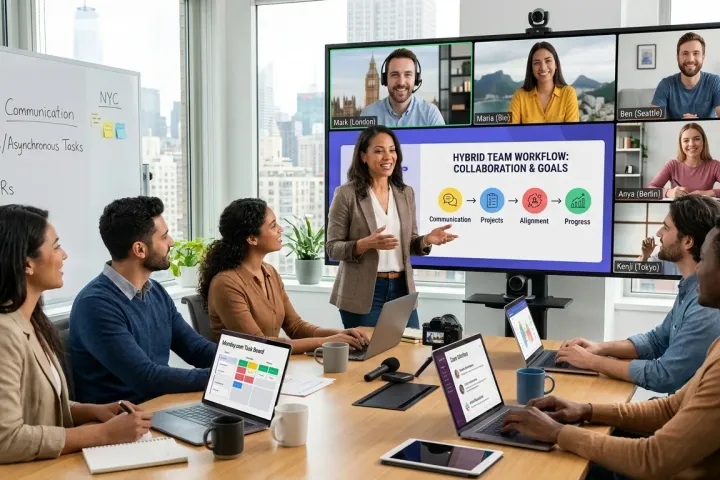
Managing at a distance is not doing the same thing through a screen. One day to set clear rules from the start, install rituals you genuinely keep, and learn to recognise and to correct without body language to lean on.
What you will be able to do
- Know the stages of managing at a distance
- Set clear objectives for remote and home working
- Put planned rituals in place with each team member and with the team
- Adapt your remote management to the personality of each team member
Programme
The main principles to respect
- The principles of managing at a distance
- Shared perspectives: the difficulties each participant meets when managing remotely
- Defining the prerequisites of remote management, in a workshop
The stages of managing at a distance
- How to raise the possibility of remote working
- The rules to set from the start
- Setting clear objectives for each person
Rituals, small and large, individual and collective
- The rituals to keep
- Organising the team's motivation at a distance
- A few tools to use
Recognising and correcting at a distance
- The balance between recognition and corrective feedback
- Practice and shared-reflection workshop
The remote one-to-one
- An essential management tool
- Each manager's own specific issues
Adapting remote management to each profile
- An introduction to a method for adapting to another person's behaviour
- Evaluation and close of the day
What this course gives you
Keeping motivation and team cohesion alive at a distance, and knowing how to combine delegation, ownership and trust.
During the day you discover the prerequisites and the essential advice for managing remotely or with people working from home. You also get time to share good practice with the group and to work collectively on your own issues. Finally, you see how to adapt your remote management to each person’s personality, motivation and skills.
Questions about this course
We work for clients in Europe and Asia. Does the course account for that?
Yes, and it is a very common case in Singapore. A regional team whose day is split between Singapore, Sydney, Mumbai and a European head office lives with a constraint that remote working alone does not create: the overlapping hours are narrow, meetings pile into them, and the rest of the day passes with nobody to ask. The course works on what the manager can genuinely act on — which decisions get taken without them, which rituals fit inside a short shared window, how the burden of early and late calls is spread instead of always falling on the same people. Contracts, working hours and formal flexible-work requests belong to your HR function, not to us.
Do we need a particular tool?
No. The day is independent of whichever video-conferencing and collaboration tools you have. What is worked on — clarity of objectives, regularity of rituals, quality of feedback — works with any tool, and no tool compensates for their absence.
How do I know if my rituals are too many or too few?
The most reliable sign is cancellation. A ritual you move twice running is too frequent or badly calibrated, and the team draws the conclusion that it did not matter. A weekly check-in genuinely held beats a daily one honoured one time in three. The day helps each person set the rhythm they can maintain for six months.
Can this day be taken alongside the manager-leader toolkit?
That is the most frequent use of it. The basic tools — the frame, delegation, feedback, the one-to-one — are the same at a distance; this day deals with what changes in applying them. It follows the core programme usefully, but does not require it.
Related courses

The manager-leader toolkit
The firm's core programme. Three days to stop settling everything case by case and to have tools that hold: set a frame, correct without humiliating, delegate for real, and adapt how you work to each person.

Non-financial motivation levers and team coaching
When your best person gets a better offer from a competitor or a regional headquarters, the rise you can authorise does not compete. Two days to organise motivation differently: twelve concrete levers, mediating a conflict, and a team vision people take on as their own.
Visual management — first level
A badly designed team board becomes a noticeboard nobody looks at after a month. One day to choose indicators that genuinely serve, a ritual you can hold, and rules that stop the tool turning into surveillance.