
Training & seminars
Management training
Managing in Singapore often means leading five nationalities in one office, all fluent in English and each raised on different rules about disagreeing with a boss — plus the team in Jakarta you mostly see on screen. Our programmes start there, not from an imported model.

6 courses

The manager-leader toolkit
The firm's core programme. Three days to stop settling everything case by case and to have tools that hold: set a frame, correct without humiliating, delegate for real, and adapt how you work to each person.
- Give constructive corrective feedback
- Bring someone back into line

Non-financial motivation levers and team coaching
When your best person gets a better offer from a competitor or a regional headquarters, the rise you can authorise does not compete. Two days to organise motivation differently: twelve concrete levers, mediating a conflict, and a team vision people take on as their own.
- Build a team's motivation agenda
- Set a challenge

Hybrid and remote management
Managing at a distance is not doing the same thing through a screen. One day to set clear rules from the start, install rituals you genuinely keep, and learn to recognise and to correct without body language to lean on.
- Know the stages of managing at a distance
- Set clear objectives for remote and home working

Visual management — first level
A badly designed team board becomes a noticeboard nobody looks at after a month. One day to choose indicators that genuinely serve, a ritual you can hold, and rules that stop the tool turning into surveillance.
- Understand the strengths and uses of visual management
- Strengthen your team's performance and sense of ownership
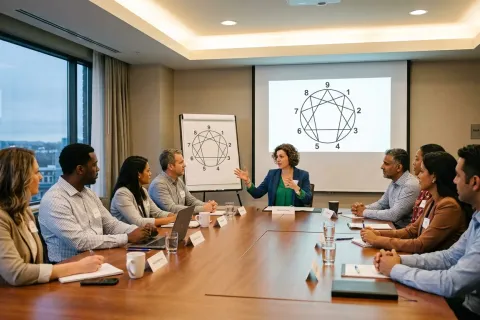
Managing with the Enneagram
The same piece of feedback produces useful reflection in one person and a month of withdrawal in another. One day to recognise the nine Enneagram bases in your team and adjust how you set a frame, delegate and motivate.
- Know the 9 bases of the Enneagram
- Know your own personality base in the Enneagram

Leading change with the Kotter method
In Singapore, change often arrives from a regional headquarters and has to land in a team that rarely objects out loud. Two days on Kotter's eight steps, applied to your own project, so buy-in is built before the rollout rather than discovered missing three weeks after it.
- Understand the human mechanisms of change, and adapt your posture as a manager accordingly
- Master the 8 steps of the Kotter method to steer a transformation project in a structured and effective way
Most management training assumes the room shares a common foundation: that everyone has learned roughly the same things about hierarchy, disagreement and how to say no. In Singapore that assumption rarely holds. A team of ten in Raffles Place, at one-north or on a plant in Tuas can bring together Singaporeans, Malaysians, Indians, Filipinos, mainland Chinese and Europeans. English is everyone's working language and almost nobody's only one, and each person arrived with a different sense of what a manager expects to hear.
On top of that sits a working culture in which seniority is respected and rarely contested in the room. A manager can leave a meeting with everyone's agreement and discover three weeks later that nothing has moved — not through bad faith, but because the objection had nowhere to be said. Many managers here also lead people in other countries, across time zones, whom they meet in person twice a year. Our programmes work on both points explicitly: how to get the objection before the decision rather than after it, and how to hold a team together that rarely shares a room.
Before the technique — delegating, setting objectives, running a difficult conversation — participants map how they themselves operate and how the people around them do, using DISC and the Enneagram. That is what makes the technique hold: a delegation method that works on one profile fails on another, and the manager needs to know which one is sitting in front of them.
Every programme is modular. A manager who already runs good one-to-ones but freezes in conflict does not need the whole course; they need two modules. Tell us the gap and we will assemble the shortest programme that closes it.
Clients ABP Consulting has worked with

























Frequently asked questions
Who are these management courses for?
Team leaders, middle managers and business owners in Singapore, from the manager taking on a first team to the one who has managed for ten years and wants to work on a specific point. Groups are usually formed by level, so the examples stay useful to everyone in the room.
What languages are the courses delivered in?
English, French or Spanish. The choice is made per programme rather than per participant: a group settles on one working language before the session, and in Singapore that is almost always English. This site can also be read in Chinese, but the sessions are not delivered in Mandarin — we would rather say so here than in the first meeting.
How long is a management course?
One to three days depending on the programme. A course can also be split into half-days across several weeks, which often suits managers who cannot leave their team for consecutive days.
Do you deliver at our own offices?
Yes, and it is the most common format for management. It allows work on real situations from your own team rather than on generic cases. Sessions can also run online — useful when part of the team sits elsewhere in the region — or combine the two.
Do participants receive a certificate?
Participants receive an attendance certificate from ABP Consulting naming the programme and its duration. These are professional development programmes, not qualifications accredited in Singapore, and we say so plainly rather than let a credential be assumed.
Is prior management experience required?
Not for the manager-leader toolkit, which is the entry point and also suits a first appointment. Non-financial motivation levers and team coaching comes next: it assumes the first programme, because it starts from what participants have made of it in the field.