
Management
Visual management — first level
A badly designed team board becomes a noticeboard nobody looks at after a month. One day to choose indicators that genuinely serve, a ritual you can hold, and rules that stop the tool turning into surveillance.
What you will be able to do
- Understand the strengths and uses of visual management
- Strengthen your team's performance and sense of ownership
- Put the tool in place
- Master running the tool and handle any resistance to it
Programme
Opening round and expectations
- Each participant's expectations on the subject
- Common-thread workshop: an analysis focused on your own department
The fundamentals of visual management
- What visual management is, and what you can expect from it
- Making team communication and mobilisation easier
- The power of visual communication
- The posture of a visual manager
- What is worth measuring in your team
- Common-thread workshop in pairs: what concrete benefit would your department get from it?
Where visual management applies
- Steering a team's activity and performance
- Setting up key standards and quality, customer-service or safety markers
- Common-thread workshop: defining your department's criteria
Keys to an effective implementation
- Ritualising: who facilitates, how often, in what form (top-down, delegated, co-development)
- Defining the ground rules and values that frame the tool
- Indicators aligned with the vision and the team, and readable colour codes
- Everyone's posture: open questions, rephrasing, non-violent communication
- Common-thread workshop: who will facilitate, how often, with which rules and values?
Continuous improvement
- The Deming cycle (PDCA)
- Running retrospectives: what works, what works less well
- Making results visible for more transparency and responsiveness
- Mind mapping and solution trees as shared thinking methods
- Common-thread workshop: which topics deserve collective thinking, and with which method?
Designing the implementation steps
- The rules and stages of change, and why co-construction matters
- Logistics: materials, boards, locations
- Common-thread workshop: announcing the change and the working sessions, involving one team member and then the team
What this course gives you
Capturing attention, motivating people and involving them in the main performance objectives, the key success criteria, the working standards and the safety rules. How do you mobilise the team around these subjects while giving them ownership? How do you strengthen cohesion and deal with issues and blockers as they come up?
This introduction to visual management lets you take the first steps of the method.
A first level, not a Lean course
The day is for managers and team leaders, possibly with their teams, and is taken with the manager of the team concerned. It is not a Lean course: project leads can be directed to a second level designed specifically for them.
Questions about this course
Is this a Lean course?
No, and the distinction matters. Visual management as worked on here is a tool for team communication and ownership, not a production optimisation method. Project leads looking for a Lean approach belong in a dedicated second level, which we point them to rather than leave them in a room that does not answer their need.
My team will see it as surveillance. How do I avoid that?
It is the most common objection and the day addresses it. Three things make the difference: the indicators are chosen with the team rather than imposed, they cover collective activity rather than individual performance, and facilitation gradually passes to members of the team. A board fed only by the manager does indeed become a control instrument.
Should I attend with my team?
It is the most effective arrangement, and the in-company format allows it. The board is a collective object: building it with the people who will use it saves the weeks of resistance a manager meets when they come back alone with an idea.
Does the tool work with a partly remote team?
Yes, provided you accept a digital board rather than a physical panel, and hold the ritual over video with the same regularity. The day covers that case, which has become common in administrative departments and regional service centres in Singapore, where part of the team is on site and part at home or elsewhere in the region.
Related courses

The manager-leader toolkit
The firm's core programme. Three days to stop settling everything case by case and to have tools that hold: set a frame, correct without humiliating, delegate for real, and adapt how you work to each person.

Non-financial motivation levers and team coaching
When your best person gets a better offer from a competitor or a regional headquarters, the rise you can authorise does not compete. Two days to organise motivation differently: twelve concrete levers, mediating a conflict, and a team vision people take on as their own.
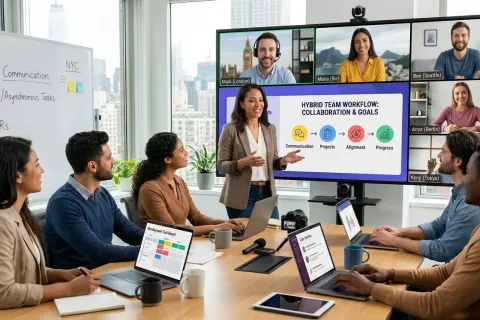
Hybrid and remote management
Managing at a distance is not doing the same thing through a screen. One day to set clear rules from the start, install rituals you genuinely keep, and learn to recognise and to correct without body language to lean on.