
Management
Managing with the Enneagram
The same piece of feedback produces useful reflection in one person and a month of withdrawal in another. One day to recognise the nine Enneagram bases in your team and adjust how you set a frame, delegate and motivate.
What you will be able to do
- Know the 9 bases of the Enneagram
- Know your own personality base in the Enneagram
- Know the base of each of your direct reports
- Give feedback adapted to each personality base
- Adapt your delegation to each base
- Motivate each person according to their personality
Programme
A reminder of each participant's Enneagram base
- The vocabulary of the Enneagram
- The main characteristics, strengths and areas for improvement of each base
Which profiles make up my team?
- Identifying the profiles around me, and which ones dominate
- Drawing on other tools and methods, depending on the trainer's certification
- Involving the team member in determining their own profile
Managing each base
- Communicating and giving feedback with each profile
- Coaching, motivating, setting the frame and correcting with each profile
- The strengths to build on
- Each base's relationship to authority
Keeping the Enneagram alive in the team
- Ideas and tips for making it last
What is the Enneagram?
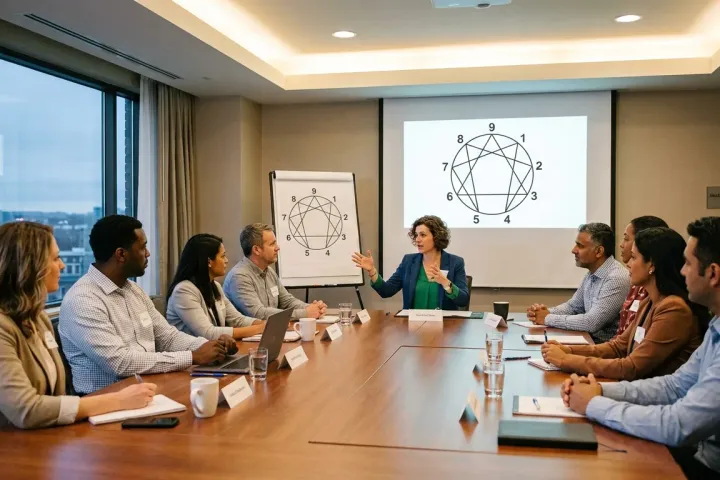
It is a method for studying personality, based on nine patterns of human behaviour. It is a tool for getting to know yourself better, and so for getting to know others better.
What this course gives you
- A better understanding of yourself and your personality, and of your team members’, to improve individual relationships and teamwork
- The ability to recognise your team members’ profiles and to practise individualised, tailored management
- Adapting the toolkit you are given to each team member’s profile, and drawing on individual characteristics to strengthen the team as a whole
- Identifying all the profiles in your team and making the most of the complementarity between their personality bases
Questions about this course
Do I need to have taken an Enneagram course first?
It is recommended. The course is particularly suited to participants who have already taken a self-awareness or Enneagram course, because it starts from each person's base to work on management. Without that foundation, a substantial part of the day goes on the fundamentals. If in doubt, we discuss it before the session.
How does it differ from DISC?
DISC describes observable behaviour and is learned quickly: it is the more effective tool for adjusting a conversation within minutes. The Enneagram works on the motivation underneath, which takes longer but explains reactions DISC does not predict. The two complement each other, and many participants take one after the other.
Can it be used for recruitment?
No, and we advise firmly against it. The Enneagram does not assess a competence and does not predict performance; using it in selection means ruling candidates out on a criterion with no predictive validity, with a discrimination risk on top. The instrument is for working better with the people already there.
Does the whole team need to know their profile?
It is not necessary, and the last module addresses exactly that question. A manager can adapt how they communicate without anyone knowing why. Sharing profiles within a team produces very positive effects when it is voluntary, and very negative ones when it is imposed.
Related courses

The manager-leader toolkit
The firm's core programme. Three days to stop settling everything case by case and to have tools that hold: set a frame, correct without humiliating, delegate for real, and adapt how you work to each person.

Non-financial motivation levers and team coaching
When your best person gets a better offer from a competitor or a regional headquarters, the rise you can authorise does not compete. Two days to organise motivation differently: twelve concrete levers, mediating a conflict, and a team vision people take on as their own.

Hybrid and remote management
Managing at a distance is not doing the same thing through a screen. One day to set clear rules from the start, install rituals you genuinely keep, and learn to recognise and to correct without body language to lean on.